

RFC on BIM Strategic Position Paper

Hi all,
I compiled a paper from AI assisted research that bears audacious assumptions that become the basis of my hobby project live here.
The paper is marked 'Theory' in that demo site. Being a newbie, I would like to have real human domain opinion rather before it goes too far off tangent.
Kind regards
red1
Comments
See if you can explain the concept here in a couple of paragraphs.
1. I convert IFC data into a more compact, easier, faster open database so as to decouple from any app restriction including Bonsai. Thus viewable on a browser. Or on a phone, no server app.
2. IFC semantics and usage is preserved.
3. Data model quickly and fully analysed it's 4D and 5D values exported to Excel. If on mobile phone with added mobile centric features such as GPS tagging for site reporting.
4. Variance analysis between versions of a building thru time and costs.
5. Now also handle non IFC model (still testing)
6. I can extract 2D layout (still testing).
7. Demo link above is ported to free Oracle Cloud that does not use server but flat file fetched and meshed out to browser viewer.
8. Free Open Source on GitHub with full documentation and testing suite.
More is taking shape. Particularly Designer from scratch using rules validation with minimal modelling.
I added more features, workable here:
1. 2D output working better but not entirely for complex buildings. DXF ready output for next stage round trip.
2. Color scheme slider for hard to see elements due to all white materials
3. Offline mode - when cut off internet can still work as cached DBs,
4. Fast merger of IFCs of different disciplines - tested working on the massive LTU A-House set. Exportable back as single IFC / database.
5. On-site building walk along tagging record keeping handling improvement.
6. Multi language mode / coupled with country codes (project rate templates editable in DIY mode).
7. DIY download whole software at one go, with templates / rates for own premise work and modification. Setup script given. No back door ET call home - all scripts available for checking.
8. Find item mode within building - walker instructions (need perfecting with walk route template for user edit).
9. Bug issue reporter - auto reply to github or my email with extracted logs.
10. COMING SOON: a) iDempiere ERP integration - drop an IFC and it breaks down construction phases and materials into the ERP model. (b) 2 screen correlation between scene tab and 4D schedule gantt chart tab - touch one and the scene animates the construction phase. (c) Auto version update for on premise downloaded app - checks latest release. (d) Multi user role mode.
11. Now declared under MIT license - thus free to use in closed mode and own distro as long as About box not taken down.
Made more changes.. short video explains in details . Try it.
Clash Analysis done here.
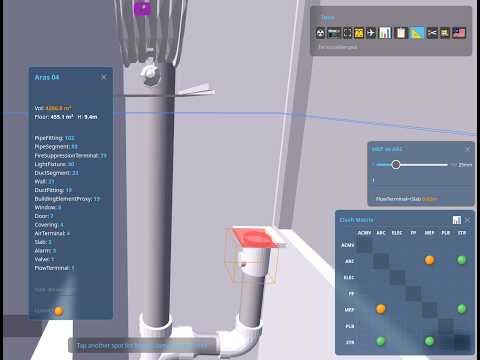
Steps:
1. Go to https://objectstorage.ap-kulai-2.oraclecloud.com/n/ax3cp6tzwuy2/b/bim-ootb-live/o/index.html
2. Drop your own IFC.
3. Click on Measure icon in Toolbar
4. Right click on any floor. Matrix will appear
5. Click on any sphere to get list.
6. Click any item on list to view the clash pair
7. Right click (long press on mobile) to Review/Resolve/Accept
8. Excel HTML tab gives visual graphical report. With CSV export.
Adapted to mobile version with snag report sharing of DB made as open for self reliance DIY offline mode
And here is some magic, sharing of Clash Analysis, via single link -
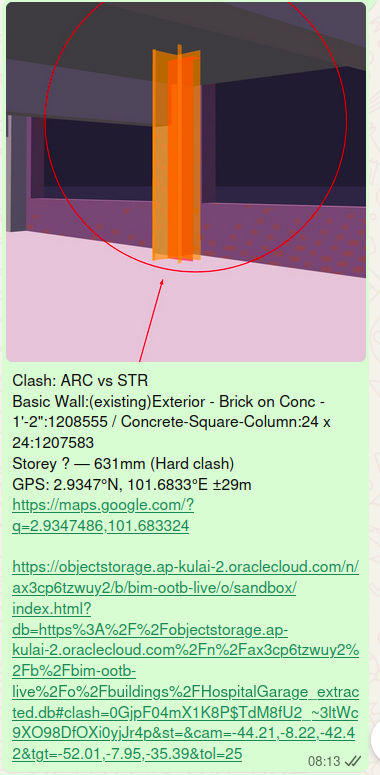
. https://objectstorage.ap-kulai-2.oraclecloud.com/n/ax3cp6tzwuy2/b/bim-ootb-live/o/sandbox/index.html?db=https://objectstorage.ap-kulai-2.oraclecloud.com/n/ax3cp6tzwuy2/b/bim-ootb-live/o/buildings/HospitalGarage_extracted.db#clash=0GjpF04mX1K8P$TdM8fU2_~3ltWc9XO98DfOXi0yjJr4p&st=&cam=-44.21,-8.22,-42.42&tgt=-52.01,-7.95,-35.39&tol=25
Ooo, this looks like you have the same idea: a persistent URL that points to a particular viewpoint in a particular BIM file. I'm proposing an ifc:// URL scheme that locates files on either git or opencde servers, what do you need from this scheme that I haven't considered?
To answer your question directly — if your scheme resolves to a fetchable IFC file, my viewer can compile and render it client-side without any server.
Here's how it works technically: my viewer runs a Web Worker in the browser that parses raw IFC using web-ifc (WASM), extracts geometry and semantics, writes it into an in-memory SQLite database, then renders with Three.js. The entire pipeline — fetch, parse, compile, render — happens in the browser tab. No backend, no install.
For a small house (~5 MB IFC), this takes a few seconds. For a mid-size building (~50 MB), around 20–30 seconds. The bottleneck is IFC geometry parsing, which is CPU-bound in the worker thread.
For sharing and collaboration, I pre-compile the .db and host it as a static file — that loads in under 2 seconds regardless of model complexity, because the heavy parsing is already done. The shareable URL then carries viewing state (camera, selected clash pair, review status) as query parameters.
So there are two modes:
Pre-compiled — .db on static storage, instant load, shareable links with full state. Faster but requires a compile step first.
An ifc:// scheme that resolves to a fetchable resource would plug directly into mode 1. What I'd add on top is the viewing state — viewpoint, selection, annotations — so the URL becomes a shareable moment, not just a file pointer.
On my end I'm making a note about source_uri as part of my compiled database schema — so when an IFC URI standard emerges, my viewer is ready to track provenance and re-fetch from it. Towards inter-interoperability.
So, the ifc:// specification doesn't have any specific clash terminology, but it can highlight objects by guid. I don't do clash detection, do reports always list two objects?
Also what information does 'review status' convey? I'm assuming that commentary lives outside the ifc:// URL - since this could include arbitrary text, images etc.. it makes more sense that the URL is embedded in an email, issue tracker etc.. than the other way around.
Yes the GUIDs clash is a pair of IFC elements that are filtered based on a JSON rule, to flag a clash condition.
I was thinking yours is more like an anchor — the client fetches the whole file and locates the GUID locally. It would be interesting if your scheme resolves server-side, returning just that element's data.
Being GUID-aware, your scheme opens up a whole world of possibility — any system (ERP, procurement, inspection, insurance) could reference a specific physical element by URI, not just a file. This is truly big for the Spatial ERP i am building. An ID_LooUp().
Ok, I had assumed a need to highlight a set of objects or a single object (the idea taken from bcf), but actually being able to address a single object, or even just particular attributes or properties of that object, has some value too.
Awesome - That's exactly the direction I'd find useful. Addressing an element's properties — not just its geometry — is where it connects to ERP, procurement, compliance. The GUID gets you to the thing, the property path gets you to the data about the thing BUT in a secured manner - the final protocol in real business applications.
Tricky but easy once the concept is right - to treat the 3D scene as the source of 2D rather than recompose outside it. Now the 2D printing is just snapshot of this - of course a cutaway filter will be used next for 'FLOOR' where we cut a cross-section above the slab plane, but include all furniture. And yes, the doors arcs. Later the big thing editable roundtrip!
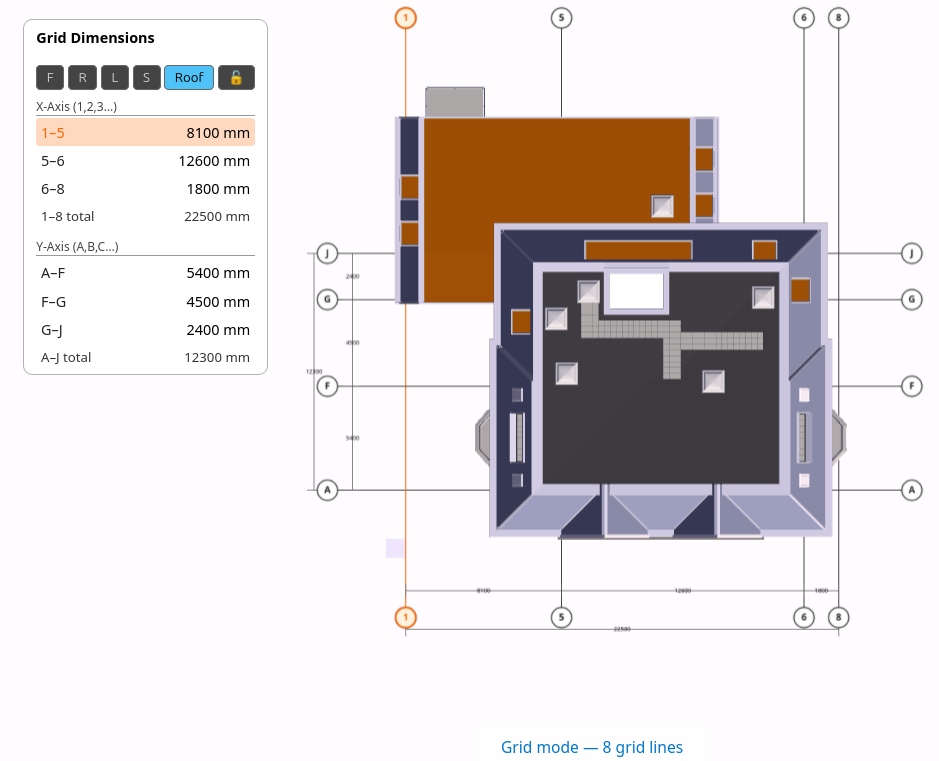
Harden up the 2D to use section cuts for combination drawings next. 4D also now corelate between Gantt and Viewer scene animation
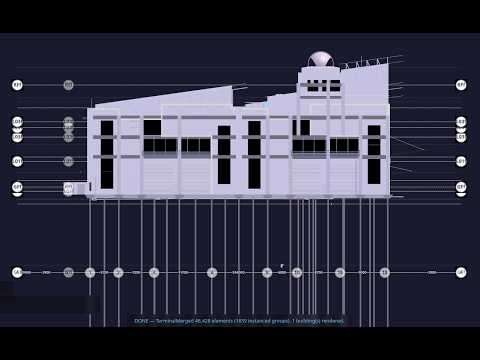
Try here DEV branch at OCI.
Here is the Gantt Chart in Action on the Viewer side, enhanced with a good dashboard. I also done a new MEP tab, follows thru on the 4D5D page. Link to that is at the bottom with my disclaimer.
The MEP tab that generates a Bill of Quantities following SMM2 work sections (R through V — Disposal, Piped Supply, HVAC, Electrical, Comms). What it does:
Japan, ASAQS South Africa, and more)
CSV export with UTF-8 BOM so Excel opens it cleanly. Or share as a self-contained HTML file
Pick a different country flag in the toolbar and the entire BOQ recalculates in that country's currency and rates — AUD, USD, GBP, EUR, JPY, KRW, BRL, IDR, and others. Each template
references a real published cost source for that region.
I'm not a QS or MEP engineer — I come at this from the software side. The rates are derived from published sources, not invented. But the structure is what matters: SMM2 sections,
unit-aware quantities, multi-currency. Someone who is a QS can refine the rates in their country's JSON file and get accurate output immediately.
The whole thing runs client-side. Drop a .db file, get a costed MEP BOQ. No cloud, no subscription.
Shareable link to try it out:
Would love feedback from people who actually do MEP costing — are the SMM section mappings sensible? What's missing that a valuer would expect?
Short cut keys and getting the 2D cuts to be more accurate.. tough cookie.. now showing the Gantt Chart Dashboard animation up close, and my next DataCentre cable trunking request challenge from another BIM friend.
You cam merge IFCs of diff disciplines -
And here is giving a gamer's experience when zooming thru -
https://youtube.com/shorts/2FHzkESHTbk
The Time Machine runs on the kernel_ops logging system inherent to the browser. Its speed and low heat signature come from the fact that it reads a pre-existing append-only log — there are no expensive spatial queries or geometry joins. Every operation you scrub through is already committed to the database from previous user actions or synthetic construction injection. Scrubbing is just replaying timestamps, not recomputing geometry. Try it out (will download a substantial but fast loading IFC/DB and play it right away).
Since Release 160 of Three.js that switches to the use of WebGPU from WebGL giving more higher scalability and finally implementing Distance Level of Detail (LOD) properly, and some more improvement on the ERP side, my forte, to eventually seamlessly commute between BIM and ERP, here is a progress video demonstration: (try it out)
After some thought i am taking on the BIM OOTB as Designer, riding on the strength of the underlying BIM Compiler and OOTB kernel ops foundation.
I integrated the Gantt Chart and runtime resources Dashboard into the Time Machine. It incredible performance comes from the just upgraded R160 WebGPU usage in Three.js on SQLite extraction of any IFC to let it run fully in the browser gain intense proximity to embedded IndexDB. My next challenge is having the Time Machine in a branched Git like scenario on the ongoing Grid based modeller under the Red Pill scene. Try it out here. https://red1oon.github.io/ootb-dev/
Project has a new home and new look - colored X-ray, and a bit better DLOD performance for large building set.
GITHUB LIVE TESTING: https://red1oon.github.io/bim-ootb/ (beta capable)
Ongoing is the Red Pill Grid based Designer
Testing R184 WebGPU in Chrome browser even Firefox is not bad though it falls back WebGL.
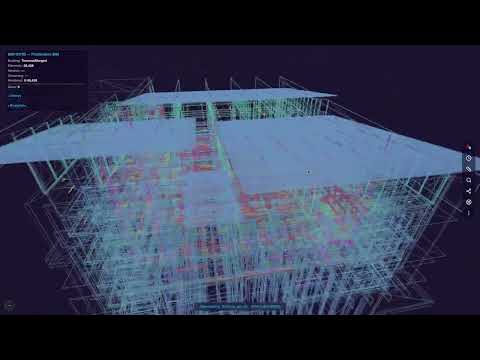
GITHUB LIVE TESTING: https://red1oon.github.io/bim-ootb/
Red Pill Grid based Designer taking shape
Here is another explanation of the underlying concept with new features and how it shall relate to the ERP as the 8th dimension of BIM
One of the little but important things - Find Panel, searching for things in a coherent organised manner. Where heavy large element size does not deter its screen speed. Here LTU A-House was lagging bad with rendering of all those meshes in x-ray thru, thus i combined it all in one big outer mesh. 2 draws, super-light experience. All this is still alpha though according to my roadmap.
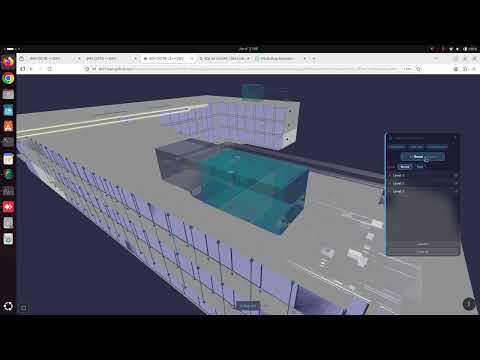
To handoff your IFC into https://red1oon.github.io/bim-ootb/
Here is where BIM closes in on the nth Dimension - ERP Project Order issued from any construction stage. ERP can be iDempiere, Odoo, Oracle et al - stick to all FOSS to ensure open standards, non obsolescence, sustainability.