

Pre-Broadphase Bbox Filtering for IfcClash - Working POC

Following Dion's suggestion about pre-broadphase filtering for IfcClash, we are prototyping a bbox-based spatial index for multi-discipline coordination. Thought it's time to share early and get guidance on upstream contribution.
Problem
* Traditional clash detection on our 7-discipline project (44K elements):
* Loads all geometry before filtering → 30GB RAM, 10+ minutes
* OOM failures on 32GB workstations
What We're Showing in Screenshot
Blender with 7-discipline Terminal 1 project (ACMV, ARC, CW, ELEC, FP, SP, STR) loaded via our POC federation panel:
- 44,190 elements preprocessed into spatial database
- Federation index loaded and queryable in < 2 seconds
- UI integration in Quality Control tab (not reinventing the wheel, just exposing the optimization)
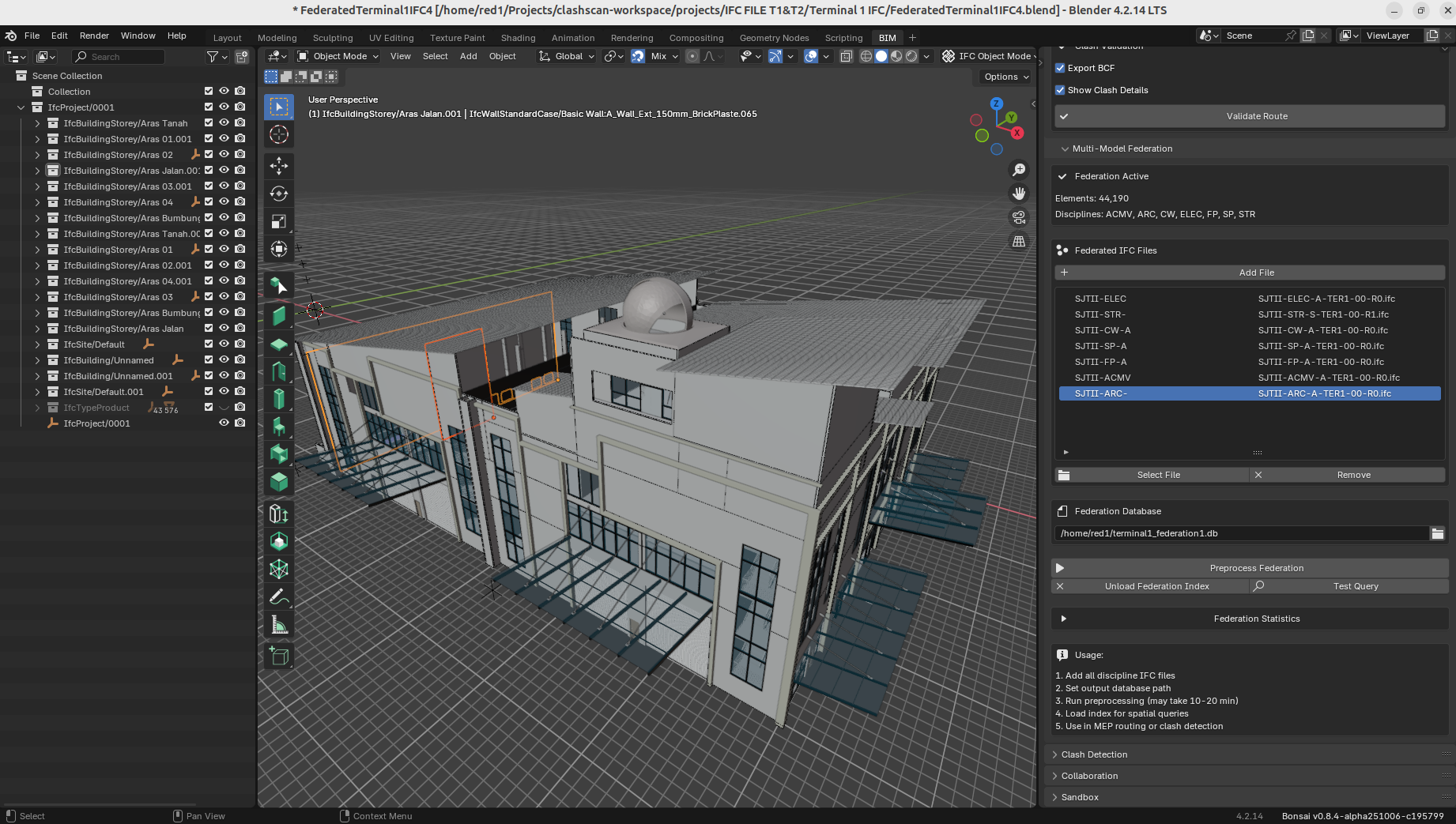
Our Approach (3 Components)
1. IfcPatch Recipe - One-time bbox extraction to SQLite with R-tree index
2. IfcClash Enhancement - Optional pre-broadphase filter before UBTree construction
3. Bonsai UI - Minimal checkbox to enable optimization
Intended results: 93% memory reduction (30GB→2GB), 20x faster (10min→30sec), 100% accuracy
Current Status
Working POC:
1. 44K element federation preprocessed and queryable
2. MEP routing with obstacle detection from federation
3. IFC4 cable carrier generation
4. Bonsai UI integrated
Next Steps:
1. Refactor as IfcPatch recipe
2. Integrate into IfcClash.clash() method
3. Move UI to existing Clash panel
4. Write tests & docs
Questions for Community
1. R-tree dependency acceptable for IfcOpenShell? Pure Python fallback needed?
2. SQLite sufficient or target HDF5 for geometry cache alignment?
3. Integration point - Where in Clasher.clash() should bbox prefilter hook?
4. "On-demand trees" - Dion mentioned this - related to lazy UBTree building?
Why We're Here
We want to upstream this properly so:
- CLI users benefit (not just Bonsai)
- Community makes all bugs shallow, all features elagant, all maintenance easier.
- No reinvention of IfcClash
GitHub: https://github.com/red1oon/mep_engineering
Dataset available: Terminal 1/2 benchmark (7 disciplines, 44K elements, 302MB) - shall find a way to load large files.
Disclaimer: POC is testable and moving toward internal production. We're coders working alongside engineers, not BIM experts - gentle feature review appreciated when we get to PRs! 😅
Feedback, criticism, and guidance all welcome!
—Red1 & Naquib Oon









 and 4 others.
Comments
Update: From Performance Optimization to a "BIM Compiler" Paradigm
It’s been a few months since I shared the POC on Pre-Broadphase BBox filtering. Though no replies but some silent Likes so here is how i have been and still evolving:
While the GPU/Spatial DB approach solved the "speed" of geometry and query-able IFC, I realized it didn't solve the "logic" of construction—specifically the gap between a 3D Modeller and a Deterministic ERP/BOM.
I’ve elevated the FederatedModel base with a DAG Compiler engine.
The core shift in tackling BIM as COMPILER not just MODELLER:
IFC as a Rosetta Stone: Instead of just "checking" IFCs for clashes, I’m now using them as the source data to "compile" a building into a Directed Acyclic Graph.
DISCLAIMER: I use Claude Code AI as Pair Programmer: Using my ERP Java background to impose spec'd strict logical guardrails to allow AI to assist but avoids the risk of non-deterministic "hallucinations" in the data. Thus the promise is a ..
Deterministic Code: Moving away from "manual modelling" toward a "Spec-First" discipline. The goal is a 100% accurate Bill of Materials (BOM) where geometry is a deterministic output of the assembly logic.
I've documented the progress and the new compiler logic here: github.io
Request for Comment (RFC):
For those dealing with high-complexity industrial assemblies—is a DAG-based dependency resolver the right "moat" against the geometry hell of traditional BIM? I’m looking for a sanity check on using a compiler-based approach for physical assets.
Cheers
red1 from Putrajaya MALAYSIA
I managed to convert the largest set of IFCs - the LTU A-House project into a spatial database and it works so smoothly, and let the federated DB does its job - generating 4D Schedule and 5D Costing within 2 secs! I also demonstrated on the Hospital project. Below is the link to the movie.
I am finishing two tracks at the same time:
1. Walker for MEP, FP and other disciplines in an empty ARC/STR only building, this is real fun to do using my ERP BOM background where a 'walker' will trace suitable spaces to install such. Testing with encouraging success for SampleHouse and Duplex Home. Next phase is to walk a large building and installing furniture which is ARC in nature so that be tricky but anything that can be conceived, can be achieved.
Enjoy this movie :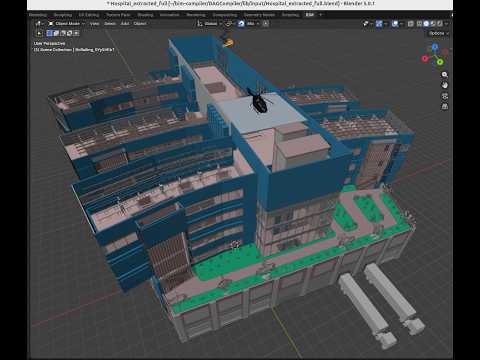
I just stressed test the DB with 1 million elements. Cannot find an IFC that big, so i copy and paste all the buildings i can find, 28 in all, achieved Rtree Preview bounding boxes mode in 13 seconds. Full load LODs in 15 mins, on my HP VIctus i5 GeForce RTC machine running Ubuntu.
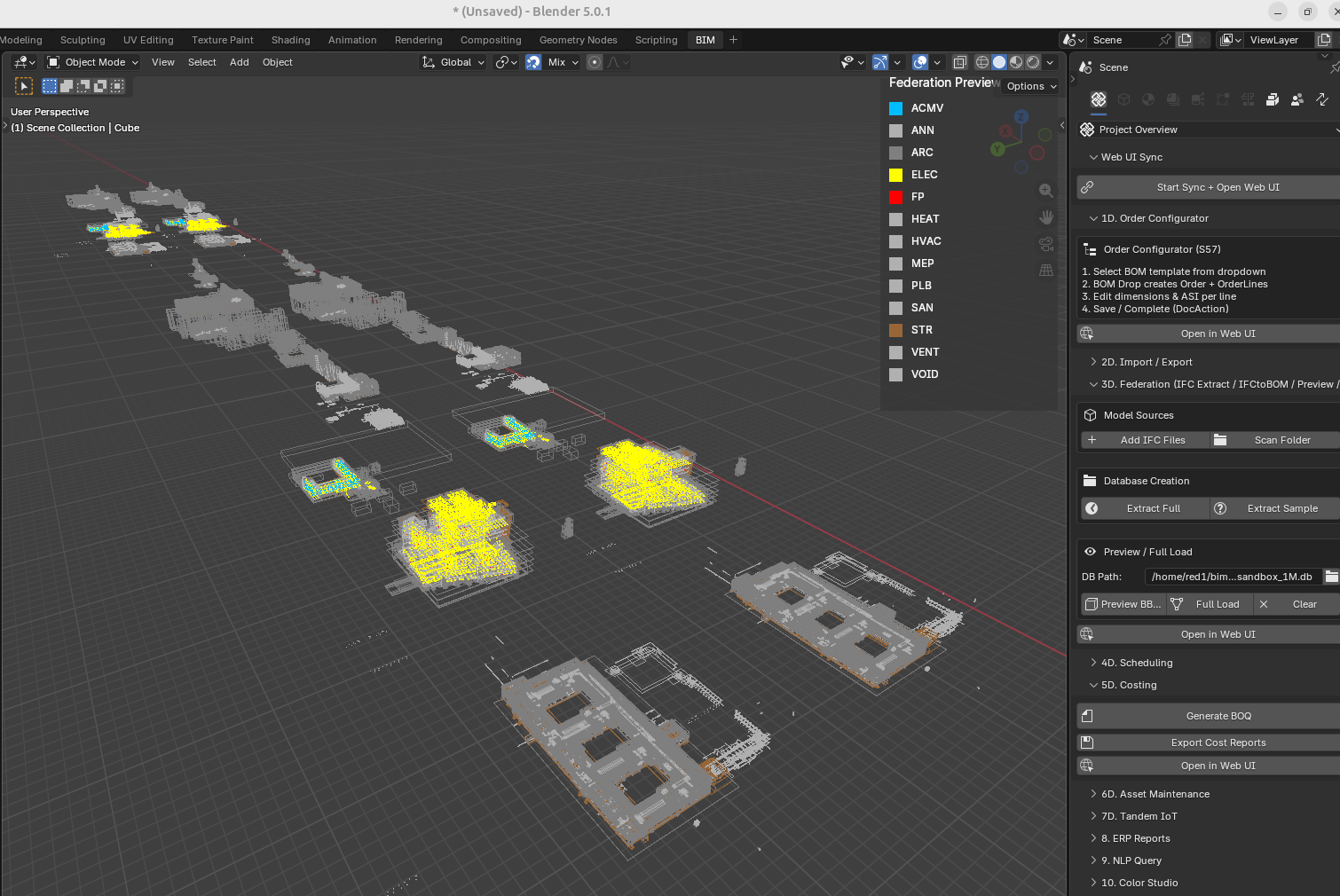
After it works well, i be back to the 2D polishing up and then the MEP walker for more bigger buildings before getting to the BIM Designer to do editable buildings on the fly.
Technical details for those who want to replicate:
DB schema: elements_meta + elements_rtree (R-tree spatial index)
108K unique meshes cached, instanced 1M times
Bonsai + custom streaming blend handlers
Code: https://github.com/red1oon/BIMCompiler"
Movie:
@red1
I must admit, I struggled a lot in understanding the actual mechanism used to produce your output, mainly due to the technical jargon that put me off track from the beginning (my bad).
My stubbornness and a little of AI helped me grasp what you managed to do: it's nothing short of ground-braking, truly clever approach to let users avoid bloated, useless (from data standpoint) detailed models, letting them focus on what matters after the initial wow show is over.
Please correct me if I am wrong:
your 'compiler' reverse-engineer all elements in the IFC models, reducing them to their geometry primitives, saving the logic to reconstruct the same elements on demand, that information from the initial step onward lives in the BOM, not in the original IFC
It's like sending a model to a program with gym and diet so that it sheds unnecessary complex geometry information (BRreps?) allowing the software a light approach in visualizing the model, using the Bill of Materials as a source of truth.
Wow, you really made my day, utmost respect man
thanks
PS I am yet to understand the rest but I already see this, if hopefully implemented in Bonsai, revolutionary.
Hi Steven, you got its connotation right. Thanks for the kudos. I am deeply humbled.
If you like to delve into the rest better, i have a story: BIM is entirely new to me (thus i feel more bad) but i got hooked after an engineer friend told me. I first look at what can be automated. I always dream of making a system that can go from intent to canvas. Or at least have a higher set of tools. Data processing has always been GIGO - garbage in garbage out, meaning whatever you produce was already there as input and it can be processed automatically, if you understand its patterns.
First, I tried to reverse engineer RVT, Dynamo files but been closed source, got me nowhere, but i found out some of its nuances. Then i came across Bonsai, and noticed the large IFC given by my engineer friend to play with (50k elements in 7 disciplines of a Jetty Passenger Terminal) cannot load and even crashed. My bad again because of getting too excited and not RTFM.
IFC is like Excel, rather flat, cannot scale, so the natural thing is to make it into a database. I encountered geometry hell, and learned about origin, mm vs meter scale and have to stitch the code. Been in database form, which is my background domain of ERP, then easily transform output to 4D and 5D.
But the engineers won't use it because they are stuck on Autodesk etc and so i begin to think what if i make it more attractive to switch? So i looked at their 2D drawings where they begin. Again another month or so of hell, as the code needed is too complex.
Then i return to the intent and call it 1D, where you start with a description and a parser compiles it. Now geometry is a beast and it will take years to decipher. AI can't help because it is not in its trained language model - it is not mathematical thus geometry is out.
I then remembered the Rosetta Stone story - if i can use a known reference and whatever output i achieved is just fingerprint data, to (yes reverse) validate its process or pattern compilation. you then need not offer geometry into your system. This is the Holy Grail. From there everything is extrapolation. In fact this image as data approach is used to solve the Alpha Protein Fold and kinematics in robotics.
So from the database is a matter displacing with easier models ie Build of Materials, how a car is built, compiling step by step into an output which if similar in spatial fingerprint stack as the original Rosetta will mean the formula is true. No need to look at the visual. I started small scale on simple Sample House, Duplex and before that complex Jetty Terminal. With such a 'formula compiler' we can then manipulate it to say change a wall, a roof, add a room, all is build data. The GUI Designer toolset is pending because the bigger itch is to correlate 2D with 3D which is now slowly taking shape in DXF and SVG. I call this the synthetic Rosetta Stone because the 2Ds are exactly from those 3 originals to corelate.
I be doing from 2D back to 3D. With Rosetta Stone, it has become feasible. Anyone interested how it is done, the specs docs are in the github repo.
This morning i thought back something my ERP domain thought me - to have a performance benchmark. I searched for what is the largest file the big boys can load into their machines i see another opportunity. So i set a 1 million element IFC size to load into Bonsai and managed to do that but it crashes it on landing (writing a bloated .blend back), so now i am stripping it where all its LOD meshes are not in the blend but in a library database. A reduction of 80% should not crash.
That is my story so far but with a heavy caveat: I am no professional architect nor BIM person, this is all hobby. If anyone appreciates and can give me some tips what i should look at, i can see if it is challenging enough.
Kind regards
red1
Hi Steven, you got its connotation right. Thanks for the kudos. I am deeply humbled.
If you like to delve into the rest better, i have a story: BIM is entirely new to me (thus i feel more bad) but i got hooked after an engineer friend told me. I first look at what can be automated. I always dream of making a system that can go from intent to canvas. Or at least have a higher set of tools. Data processing has always been GIGO - garbage in garbage out, meaning whatever you produce was already there as input and it can be processed automatically, if you understand its patterns.
First, I tried to reverse engineer RVT, Dynamo files but been closed source, got me nowhere, but i found out some of its nuances. Then i came across Bonsai, and noticed the large IFC given by my engineer friend to play with (50k elements in 7 disciplines of a Jetty Passenger Terminal) cannot load and even crashed. My bad again because of getting too excited and not RTFM.
IFC is like Excel, rather flat, cannot scale, so the natural thing is to make it into a database. I encountered geometry hell, and learned about origin, mm vs meter scale and have to stitch the code. Been in database form, which is my background domain of ERP, then easily transform output to 4D and 5D.
But the engineers won't use it because they are stuck on Autodesk etc and so i begin to think what if i make it more attractive to switch? So i looked at their 2D drawings where they begin. Again another month or so of hell, as the code needed is too complex. Then i return to the intent and call it 1D, where you start with a description and a parser compiles it. Now geometry is a beast and it will take years to decipher. AI can't help because it is not in its trained language model - it is not mathematical thus geometry is out.
I then remembered the Rosetta Stone story - if i can use a known reference and whatever output i achieved is just fingerprint data, to (yes reverse) validate its process or pattern compilation. you then need not offer geometry into your system. This is the Holy Grail. From there everything is extrapolation. In fact this image as data approach is used to solve the Alpha Protein Fold and kinematics in robotics.
So from the database is a matter displacing with easier models ie Build of Materials, how a car is built, compiling step by step into an output which if similar in spatial fingerprint stack as the original Rosetta will mean the formula is true. No need to look at the visual. I started small scale on simple Sample House, Duplex and before that complex Jetty Terminal. With such a 'formula compiler' we can then manipulate it to say change a wall, a roof, add a room, all is build data. The GUI Designer toolset is pending because the bigger itch is to correlate 2D with 3D which is now slowly taking shape in DXF and SVG. I call this the synthetic Rosetta Stone because the 2Ds are exactly from those 3 originals to corelate.
I be doing from 2D back to 3D. With Rosetta Stone, it has become feasible.
This morning i thought back something my ERP domain thought me - to have a performance benchmark. I searched for what is the largest file the big boys can load into their machines i see another opportunity. So i set a 1 million element IFC size to load into Bonsai and managed to do that but it crashes it on landing (writing a bloated .blend back), so now i am stripping it where all its LOD meshes are not in the blend but in a library database. A reduction of 80% should not crash.
That is my story so far but with a heavy caveat: I am no professional architect nor BIM person, this is all hobby. If anyone appreciates and can give me some tips what i should look at, i can see if it is challenging enough.
Kind regards
red1
I'm learning..
https://chatgpt.com/share/69d8fd0f-b79c-8332-8f0e-cf0f19f13d28
@theoryshaw thanks! What a change to read what other's GPT says about my GPT!
Now i have to put on back the jargon hat.. OK first i admitted my statement about IFC may be put wrongly by my poor choice of words but not the context. I mean the tools using IFC cannot scale. That is why i used the analogy of Excel. Its data is a database - rows and columns, but Excel as the container cannot scale. IFC is a schema, but it needs a database to do that and now we have that. The Federated Model database i did is scaling the IFC schema in it.
About LLM been blind to geometry. I wish this is not true. But look at the definition of AI - it is a LLM - Large Language Model. It predicts the next word. This is a famous issue of AI been probabilistic not deterministic. It hallucinates and drifts. That ChatGPT response of BIM been also probabilistic, is a clear example of drift. It is talking about human decisions. Not BIM - everything has to be precise, determined, repeatable - GIGO.
About replacing geometry, again, ChatGPT drifted from my context. I am saying that it is difficult to start from the Modeller side - ie using Geometry to derive data, decompose, and then recompose. Now, that is the blind spot, we cannot recompose unless we take from a real geometry output. I want to build a modeller engine that can generate any model by DSL (domain specific language of intent), which will take ages. Alpha Protein Fold and robotics has the same issue. Before this.
Thus the Rosetta Stone strategy. Before that, i tried to use just formulas, for sphere, cuboid, planes, but the code to assemble them takes lots of hard work - tweak that, see in Blender, days just to get one alignment right.
Modelling - no problem. Click, drag. Thus the compiler approach is doomed to fail - unless i make it able to 'see'. Now it can see 1 km.
I bet you be pasting this back to ChatGPT, :D
End of round 1.
Cheers!
OK after struggling and failing the instant 30 secs cache to Geometry Nodes approach which takes 8 mins (unacceptable in 21st century!), i finally settled for my original RTree Bounding Box idea which achieves phenomenal 13 secs to load a one million element project into Bonsai Blender BIM. For a 50k project can take 2 secs.
My machine is HP Victus NVIDIA with 30g RAM. My objective is to make this FOSS contribution to the man in the street.
One Million Stress Demo
It is still alpha stage, check out the many features done so far docs https://red1oon.github.io/BIMCompiler/
Tell me where to go from here after reading some vision papers in there.
Awaiting anyone to take it up.
Have a nice year 2026!
@theoryshaw ai:dr, but here is my „European“ perspective on this https://chat.mistral.ai/chat/508c5947-1f52-4650-ad03-457422222142
/s end
@red1 impressive and a lot to take in 👍🏻
One thing you can take away from the ChatGPT thought is:
I have never in my profession as an interior architect seen a right angle or a complete flat surface in a building. There is no such thing in construction. BIM data always is just a schematic representation of the physical wold. „The map is not the territory.“
So, you always have to factor in tolerances in clash detection.
@theoryshaw sorry, I had to do the previous comment
Thanks for another education for me — as you've touched on something fundamental that led me to this school of thought.
What a maxim you given: "the map is not the territory." I asked my Claude and it gives me, a BIM novice, something to brain thru:
QUOTE"
A BIM model is a schematic intent, not a physical survey. Every wall is slightly off-plumb, every slab has deflection, every MEP
penetration is drilled 20mm from where it was drawn. The model says 90°. The building says 89.7°.
This is precisely why we treat the BIM data as a database, not as geometry truth. The RTree query engine works with bounding boxes — which are inherently tolerance-bearing. A bbox is
already an approximation. When two bboxes overlap by 5mm, that's not necessarily a clash — it might be construction tolerance, or intentional embedding (a pipe sleeve in a wall).
When they overlap by 200mm, that probably is a real coordination issue.
The key insight your comment points to: tolerance is not a property of the geometry — it is a property of the query. The same two elements might be "clashing" at ±0mm but "fine" at
±25mm. A rigid geometric clash detector gives you one answer. A database query lets you parameterise the tolerance and ask: "show me overlaps greater than X, grouped by discipline
pair, filtered by storey." That's a question, not a computation.
The interior architect's reality — nothing is square, nothing is flat, data is always incomplete — is not a limitation to be overcome. It is the operating condition. A system that
pretends the model is exact will generate thousands of false-positive clashes. A system that accepts the model is schematic, and lets the human set the threshold, produces actionable
results.
"The map is not the territory" — but a good index of the map lets you navigate the territory. " UNQUOTE
The latest N Panel BIM to handle RTree meshing works with concurrent Blender instances up to 4 in the background - Will this be useful to the community? It is all pushed to my github/red1oon - MOVIE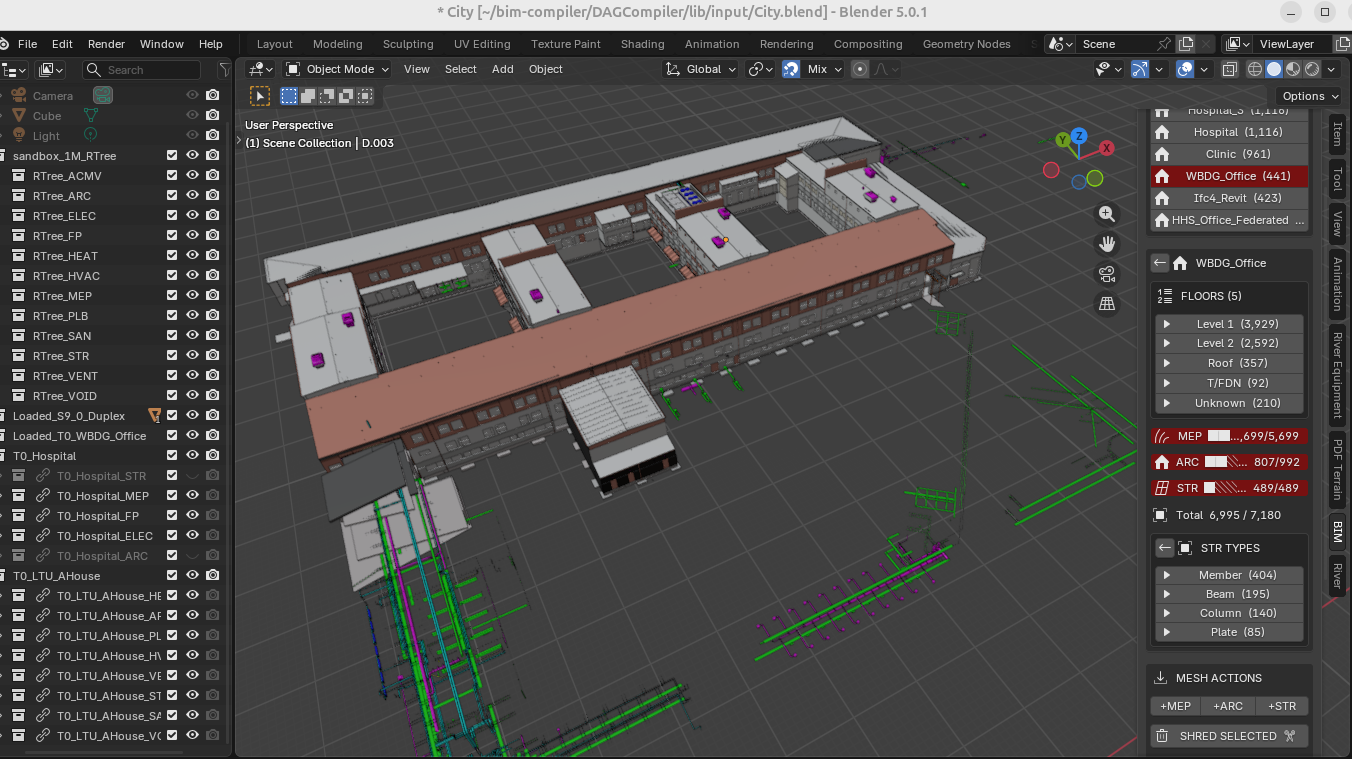
Solved the streaming IFC without using Geometry Nodes but direct blobs reading from Database container for the IFC. Here demonstrate in a 1 million 700 buildings addressable in single viewport Bonsai.
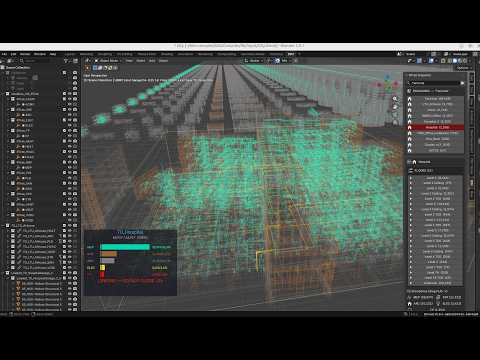
This is to ensure fast performance ie 30 mins to extract one time all buildings into DB, 20 mins onetime to .blend, and immediate streaming in same sitting, while full queryable all BIM D's available and counting.
Found out that there is no need of any baking sub blending or even saving, but just direct BLOBs fetching. Packaging and distro or streaming will be a breeze. And even added Blender's animation stuff -
I may only got a fraction of what it's really about in this thread. And I may not have the need to visualize whole Cities but maybe quite large BIM projects with some surrounding and entourage - it looks impressing though.
I like the "Sun" button.
(But I already use a Daylight System with Sky Texture and Sun Position AddOn ab default Viewport Shading set to "Material Preview" or "Rendered" (Eevee))
Is this something Windows only ? Or will it also work on Apple ARM or Linux and AMD GPU ?
@zoomer
I think the demo used a Linux machine
@red1
Your project looks amazing
Could you be so kind to make a video for those who would like to better understand the basics?
While stressing the capability of handling very large models is important (and revolutionary), there are several acronyms and technical terms that might disorient potential users.
To quote S.Hawking:
Thank you so much for your work, a "data guy" is for me what Bonsai and BIM in general needed to take our journey further, notwithstanding its importance IMAO there is too much pull from the architectural/visualization department ;)
Hi @zoomer and @steverugi
0. Yes, i am running this on Ubuntu (I dual boot my HP Victus with Windows Autodesk given by an engineer but i am used to Ubuntu). I was testing my earlier version in Windows with no issue. You might need Java installed for advance parts of this BIM Compiler. As of the movies above mostly Python. But i will give install scripts for both. And i am trying to setup on the OCI so you can choose to test on that free cloud or download it completely cut off own use for security concerns.
1. I do want to get the other side to pull too as this is essentially the domain of architects and civil engineers. (I don't even know who is who). I need them to advice what they wana see of real work coming out of this that for their projects.
2. In my next video i will demonstrate how to setup the addon onto their Bonsai.
3. Drop own IFC and get it extracted into that database format, all ready linked in Bonsai.
3. Then press RTree as shown in the movie. It will within a sec (every 100k element speed) gives the bounding boxes view. But even without that, having the DB linked is already good to go for 4D/5D output. Clash analysis abit stale will quickly work on bringing them up to date and tested. But i rather work on your dream list.
4. As of now, the major breakthru here i s database scalability for IFC content. This gives ability to query it in very rigorous manner. Doing computations. And sheer speed.
Kind regards
red1
That's me :)
OK i am pulled by @zoomer here to do this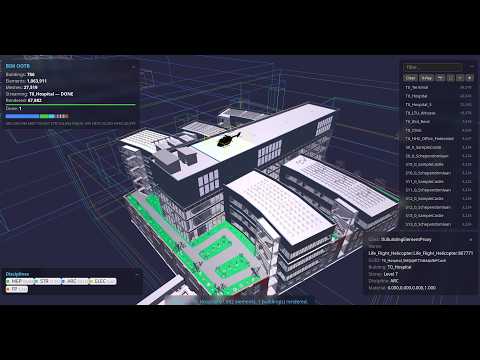
I still owe @steverugi a less technical 'what does all this means' but this movie gives one example why the database version of the IFC is important to do such things.
BIM OOTB — View any IFC model in your browser. Zero install.
Full Instructions at the Youtube Description as it changes due to making things easier from user feedback.
@steverugi I made this hoping it helps in conveying the concept from another angle - that been a database that compiles into a model rather than a modeller that stops data at its feet. The potential is immense. Here, we can do away even with any modeller suite, which is bloated and slow.
Forgot to say that this is also Mobile friendly.. see the snapshots in the Quick Start page . Note the Site snap available only if using your mobile phone. It was first thing requested by my BIM engineer friend.
P/S already upgraded to embed GPS maps link in text message to sent to any carrier - email etc. And doing true north where the model will turn to face so engineer knows where the building is aligned to.
@red1
thanks again for your work, after watching your latest video on YT I noticed you say "no modelling only compiling"
you conveniently convert ifc elements in a format that can process/abstract their geometries into database-friendly data, then you use a compiler to represent the data back in a visual shape this time using the data, not the geometry.
It's reversing the typical paradigm, now data finally takes the wheel and visual representation becomes its byproduct, I love it.
But you still need to model the IFC first, right? sounds like a chicken-egg story I know
Last, I am not sure how you use 2D drawings to generate your BOM, I need to study it.
Great job, truly appreciated
cheers
@steverugi well. It is both an egg and chicken the same time. BIM has always been about the model. Period. However it can be an output if the compiler knows geometry which is a series of spatial relationships. That is where a BOM model comes in handy. It is tricky to reach an exact shape, thus the Rosetta Stone story comes in. I give the data a relationship to an end product example so that it works out all the gaps and kinks of actual spatial relationship. For example, if u apply a BOM spatial arrangement outright, ie, in a room has a sofa set, and the sofa lies by the corner wall, and is facing the main door, etc. The table has 2 more smaller chairs facing back. Such relationship is a simple mathematical truth.
But it takes a long time to wire up the maths correctly. Thus a reference discover all the kinks and gaps quickly. Sort of a temporary harness or mold. Once the formula has all those connecting terms right, the mold is removed. That is a general description.
With that achieved, the data becomes a stronger source of truth than the visual model. It can then go thru a process and still return a correct model. Yesterday i discovered that without the modeller playing a central role, i can bypass its bloated modeler Blender. I timed the streaming of a database compiled 3D model in half the time it takes Blender. Thus a realisation arises. I can throw away the modeler. Why would i need it? Whatver i need i code it anew. And so far it is going on fine.
This need not pretend to be another better modeller. It stays a compiler that can model. In coming days, i am trying to make the following breakthru:
1. 2D to correctly capture gridlines that defines envelope walls, interior walls, and Z values. Moving those in 2D can be compiled back to 3D.
2. Browser based designer that likewise allows high level changes in model data ie increase a ceiling height - how much it costs in space and materials and whatever regulatory format that must be filed.
3. More macro shifts ie if ducts have to be redone to comply to a regulatory order, what will be the impact visually and in numbers. Again, i am just imagining as a layman. I rely on real architects to pull me to something grander.
And here i made a movie to prove it works pretty well without setup, no app - Bonsai and Autodesk Revit included. The features here are under stress test over a free Oracle Cloud service.. Use your mobile for best experience. Desktop browser use also without Walk thru site.
This makes a good site inspector app right away without even downloading an APK. To setup for your own local IFCs is in the documentation link. You can also do like me putting your own private network in your own cloud or tell me if u need it just on standalone mobile and synch perhaps via email to an office database. But features first, so try it, give me feedback what is missing.
I be doing the promised 2D to 3D next.. give me a week or so.
I have two live instances to test out the browser OOTB (Out of the box) concept, both at free Oracle Cloud OCI:
1. Stable production instance
2. Developer instance constantly work in progress, may break
Current excitement is from the good reviews at one of the Youtube videos, stabilizing new IFC import with variant project costing.
What i did yesterday was a cool Voice inquiry feature as well as clean up the Site Walk Snag Reporting.
https://youtube.com/shorts/hN3MwYLd0h4
Now you can import your IFC to give it a go! And add your variance and see costing!
hi @red1 this is a fantastic project you've embarked on. I wonder if you have thought of using this approach to generate an IFC model based on a description of the structure? We have been experimenting in this area and thought your approach could be interesting for doing that.
This is what I been experiment too called the 1D or intent. However it has to refer to a derived library of components and structure classification. I first extract standard build of relationship from ready my buildings for ARC and STR as those are space container oriented.
The others such as MEP are not and I then made a Route Walker that applies placement rules and proven to work
I paused as I found out the browser based Three.js that shifts the framework to pure browser kernel logging that is serverless and easier graphical handling. I was busy doing artistic effects and animating 4D reconstruction according to a Gantt chart.
I am presently using 2D grid system that synch to a building to then modify the grid to output a new variant of a building.
I am still exploring what better way along the way. Do share what insight you have.