

Will AI help or hurt open source communities?

Have been thinking about this a lot lately...
Had an interesting chat.
https://chatgpt.com/share/6a08a967-20ac-83ea-87e2-a9bb7d46db1e
Thoughts?

Have been thinking about this a lot lately...
Had an interesting chat.
https://chatgpt.com/share/6a08a967-20ac-83ea-87e2-a9bb7d46db1e
Thoughts?
Comments
Have been thinking about this lately too ...
Because of @yorik complaints with AI in FreeCAD.
Which had some concerns and arguments I had not yet on my radar ....
Which got me thinking that I have quite some disinterest in AI, because of my not so satisfying or successful first experiences with AI (chat bots/LLMs more than image generating) - but have still no real opinion.
On the other side I see your impartial usage of AI and finally your productivity in regions far off your initial architectural background ....
I think these tools can't be ignored, they really work, but also they are completely unsustainable - both in the ecological sense of power and water consumption, but also that these companies make no conceivable financial sense.
@brunopostle could you share more infos about AI unsustainability and water consumption?
@Massimo the energy consumption is huge, but this requires an equivalent amount of cooling. These compute data centres no longer rely on AC, they use freshwater evaporative cooling: https://harvardsciencereview.org/2026/02/28/re-architecting-the-ai-server-the-hidden-water-cost-of-data-centers-part-ii/
@Massimo
Sabine is my favorite scientist on the tube :)

but the master of the skeptics is Ed Zitron, his position may be considered controversial but for what I understand is mostly based.
No one is against AI in principle (much less myself) but the way it has been promoted is quite frankly unrealistic, there is simply no power to generate the 'compute' needed, there is no business model to make it profitable unless as side project of major corporations, the capital expenditure is insane.
On the coding side I know very little, but I understand the concept of cognitive debt , by many considered as an overload for companies rather than time or cost saving. So the story that you can buy tokens to have agents to replace your juniors doesn't stand on its own legs, at least at the moment or in a short term.
Lastly, misusing AI turns us into the humans from the movie Wall-E — lazy, dependent, and so out of shape that we can’t even walk by ourselves. But it's an excellent tool to automate certain processes already, so I am positive ;)
@brunopostle
good read, thanks
on cooling the situation is apparently less dire than power consumption, closed-loop technology now being introduced, saves a lot of direct use of fresh water, the elephant in the room in my opinion is power consumption, after years (decades) of promoting energy saving procedures AI received a blank check with little to none public consideration.
If put together with the current state of power grids and the massive electrification exercise run in many countries, including increased use of EV, it's not difficult to see the limits of what proposed as "the solution"
Generally speaking, a rule i use to decide if i can use AI generated stuff is asking myself "Am i understanding what it is done and i can modify/manage it?"
Some observations about the practicalities of open source development (ignoring the environment for the moment): I am utterly convinced that right now, left by itself, AI will create broken software. The more it produces without guidance, the higher the risk of killing the software.
The skill for developers is now I feel to "catch up" to AI. I feel like I've got an eager hound. It's so easy to press the enter key and have it "just do things I tell it". And it can write faster than I can read. It can give the illusion of understanding faster than I can I can truly understand. So that's the real challenge ... can I read fast enough to keep up, and not just skim-read, but truly digest-read to see the software patterns and connections in my head. Because I'm not so much worried about syntax (or nitpicking opinionated dev stuff anymore), I'm worried about the "shape" of the code. The "smell" of the code. The "intent" of the code.
I now spend time just ... reading code. Reading and talking to myself and AI. I use AI as my reading companion - I share my screen and talk live with Gemini and read the code aloud in my own words and the AI either confirms or argues my point, and I argue back at it. It's like continuous rubber ducking with a PR generator. It's these reading sessions (and the AI debates that happen after I reach some conclusion) that steer the next round of code generation. I'm still struggling with it, and it's a constant balance between steering and losing control.
... but let's imagine it's doable. Let's imagine we are able to "work" in this strange new form of "just enough" fact-checking and micromanagement of AI output.
The next question is how on earth does this work in FOSS? The datamodel branch with the work @aothms has been doing (which recently merged in the IfcViewer stuff up to a checkpoint) is ... believe it or not ... +411,393 -365,768. Read that number again.
Four. Hundred. Thousand. Lines. Changed.
... and this isn't by a non-coder burning tokens without knowing what's under the hood. This is (mostly) by Thomas. He knows what he's doing. We all trust him to do right by IfcOpenShell.
And in the past three days, another. Eight. Thousand. Lines. Modified.
I'm sure those lines of code fit in Thomas' head. And the thousands of lines that I've AI-produced fit in my head. Probably not as deeply digested as the Bonsai code I wrote by hand, but I know what each file does and contains (apart from some of the more mathematical algorithms which I just trusted AI).
How can the rest of the community keep up? In the past, if a company "released" waterfall-style code to open-source without the slow drip-feeding of commits, we would never consider it truly open-source because there was no way for the community to comprehend it. But such is the nature of ultra-fast code generation now. What does comprehension mean? My best guess right now is that the volume of code is "shaped" and verified by the developer to reflect the true developer's intent, rather than "oh the AI generated it and I assume the AI is on the same page as what I envisioned but I never checked". Because now the code is the source of truth, and the only way to make sense is to read the code (perhaps with AI assistance). But is that collaboration? If you want to collaborate, you do the whole read and mass build ... but how do the core devs build trust with you as a contributor? In the past, they'd have to review (small) PRs ... but maybe that makes no sense anymore? Maybe we need to go back to actual voice calls and discussions and talks about code structure. Little "show and tells" about this is the shape of the code and why it is that shape.
... dunno just braindumping.
@aothms be like...
;)
So just regarding that number. That also includes generated code for the schemas. And I also asked AI to apply consistent naming conventions.
I think I would like to work towards clear levels of understanding: use cases, modules, data models, function calls. I'm beginning to feel ok if I don't read every function body given there are three things: (a) clear data models with explicit intent (I prefer to write them myself, AI is either pretty bad or my taste is atypical) and (b) clear invariants, pre and post conditions to what the function needs and can be expected after completion (c) tests. With this structure in mind I feel that I can still work top-down instead of fully open-ended AI slop. If, on the other hand, I start to actually read all function bodies I start fiddling with the horrendous verbosity and probably could have better done it myself from scratch.
And the same applies to the community, for most their level of understanding will stop at use cases and that's fine. How many lines of curl, grep or inkscape have I read? For review it'd be good if we can focus on data models and function invariants, pre- and post conditions - and the intended scope of the feature narrated by tests.
Completely agree - I think the single biggest thing that will keep projects alive in the AI age is strong tests and clear data models. Really strong definitions and naming and code structure.
Also just to emphasize for others reading along 400k shouldn't be taken at face value - but even if it was 95% generated, 20k is still significant, and even if that was all non-logic, simple changes, like spelling errors for example, 20k is still a lot of mental throughput or sheer scrolling and mental categorisation.
As for the financial part it is worth to read some pieces by tech & financial covering journalists, one example here: https://bsky.app/profile/edzitron.com/post/3mlvw4gyh4c2v.
If you have lived through the DotCom bubble and the Subprime crisis, you will see the same patterns repeatedly.
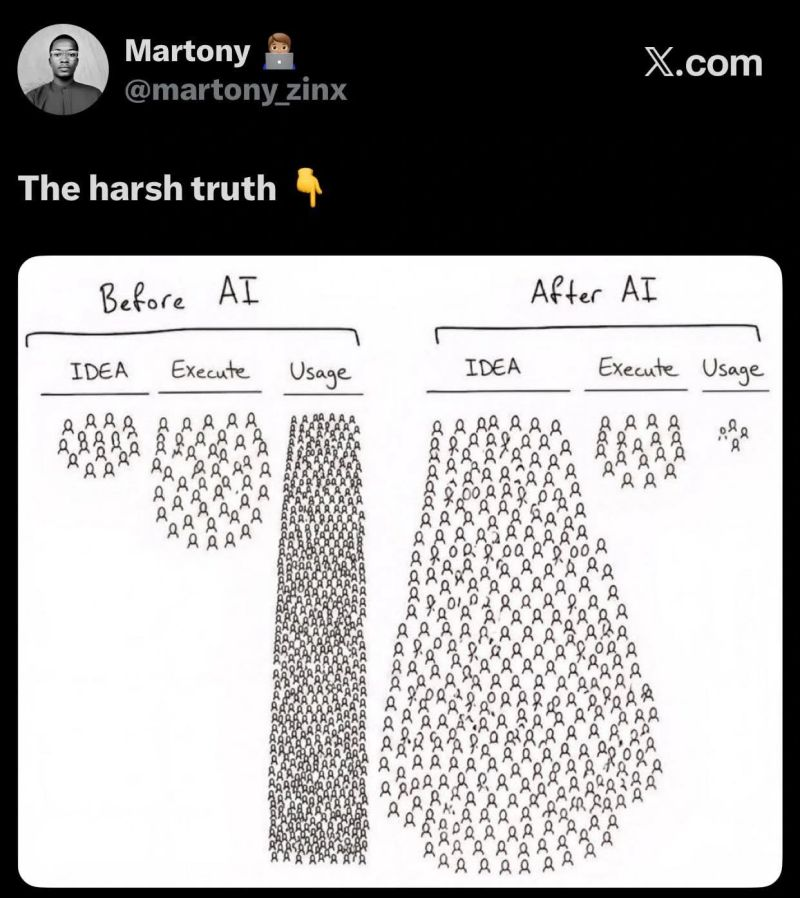
Saw the following meme today. From this perspective, a community might be more essential in the days of AI--to bolster and justify usage.
Moult's point about the "shape of the code" is exactly where I spend most of my energy. I build an open-source IFC tool and ship AI-assisted features — natural language commands, AI clash titles, an MCP server — and the thing I've noticed is that AI is genuinely useful for the plumbing: cache layers, geometry math, serialization. But the decisions about what belongs where, what to expose, what to hide — those are still completely mine, and they have to be, because the AI has no sense of the product's long-term shape. The code it writes fits the prompt. Whether it fits the project is my problem.
The sustainability concern is real too. I use Gemma 4 on the backend specifically because it's free-tier and lighter. It's not perfect but it keeps the tool free to run, which matters when you're open source. Running GPT-4 at every request would not.
Why open source communities might become more important in our AI future: https://chatgpt.com/share/6a4e6e8a-3120-83ea-8d94-62ef2233dddc
Hm I have different fever dreams, but related. I do think the key is indeed in documenting what works. But I'd much rather have the graph be the code. One problem is that git is very linear. In a different universe I had hoped something like https://darcs.net/ would have been more mainstream where you can more freely look at your version control state as sets of commits where you could combinatorially compare alternative approaches and document failures and successes. Not only with AI is investigating multiple alternatives becoming cheaper, the fact that behind a commit is a prompt or instruction it might also mean that it is more easily replayed/rebased (if only it would be a bit more deterministic). Maybe AST-based diffs are also a factor here.
One thing I see more and more in different forums is that people paste their AI conversation. I am also guilty. I did it twice in this forum. The first time because I didn’t know better, the second time to prove a point.
Honestly, this is annoying AF. Especially if it is posted in a forum dedicated to open source and the first thing I have to do is, log into a proprietary software to just read what is posted, let alone walk through a wall of text.
Can we agree to stop this?
I am not interested in what the AI thinks, because it can not think. I am interested in you, a human and in your human thoughts. Nothing wrong with learning with the help of AI. But please everyone, have the decency to write your thoughts in your own words.
Otherwise I’ll just ignore it. aidr!
@doia
Yes, I too consider copy-paste from AI a sin. I use it for proofread purposes or to check if some terms are appropriate before posting my rants.
100% !
A follow-up question: is copy/pasting code, a sin, as well then?
If the answer 'it depends on x/y/z"
What then, is the x/y/z criteria, in your mind?
I'll give a counterpoint. I've found it quite interesting reading Ryans recent posted chat logs. Some things there that made me think.
Also I think it depends on why you are posting AI output. I've just been fighting with Inkscape. Crashed every time I tried to open a Bonsai-produced file. I went through a Claude powered investigation. I was going to report a bug¹, and I asked Claude to summarize the findings for the bug report. I've worked in IT for a long time. I would weep tears of joy to receive bug reports like that from a human. Clear, concise, logical, and all the pertinent info. It did it in about 10 seconds - would have taken me a lot longer.
¹ Turns out @theoryshaw raised the same issue last year. Basically if the Selector CSS dialog is open when loading the Bonsai file, it pegs at 100% for 5 mins, then core dumps. Seems that part was badly written and temperamental. Apparently they've now changed that part in 1.5, so I don't think they'll want my beautiful report. I'm just spinning up a VM to see if 1.5 fixes the issue, or if Bonsai drawings are still a step too far.
@theoryshaw
according to the open holy inquisition you can buy some ifc compliant letter of indulgence to save your head from being chopped off, your call :D
My point was for those users who write by proxy, using AI or plagiarism from other posts to appear cool or competent
Among other things I'm a sinner too, just a bit, since I do use AI to quickly get some code for automating tasks, but IMAO I won't need atonement since it's me directing and cross-checking it, which I must fully understand, (@Max docet) there is no copy/paste per se if not for testing the code. It's like using a smart typewriter or word processor instead of handwriting I think
So, in your own case, ego te absolvo a peccatis tuis in nomine..
Cheers!
There is a distinction between a rather technical code/bug analysis, where you use a tool to summarize the findings into a concise format, similar to automatic linting/formatting/grammar correction.
On the other side there is a real discussion and understanding of topic which you want to share with other humans to find common ground. Or a solution. Or a new way to see things.
Sure, AI can help you formulate the points you want to talk about. By chance it will even give you points you haven't thought of. But do not make the mistake and assume AI thinks. It does not. It is just repeating the statistical mean it has in its training data. You just not outsource thinking, you avoid it.
And here is the thing. I am not interested what the tech pulls out of its training data. I am interested in your genuine human thoughts.
If a poster not only just pastes AI output, but furthermore only posts a links to another closed system, it shows me laziness. Too lazy to think for yourself, even too lazy to bother with copy-pasting the conversation.
So why should I bother reading it?
However you frame the prompt "Will AI help or hurt open source communities?" to the machines, they will try to please you and come up with an answer. "Great question, bla bla bla". It's the illusion of thinking.
Don't get me wrong. AI can be a great tool on processing huge amounts of data, in gathering information, in bringing order in seemingly chaos, in categorizing, in data transformation, in methodically pinpointing buggy code, in processing huge error logs.
But it can not think! That you have to do yourself. Especially in a forum from humans for humans.
I think those of us who post AI chat links (myself included) don't take them as gospel. They're ways, as you said, to tease out an idea you already have, or to expose angles you hadn't thought of. Brainstorm snapshots, basically. That's ultimately why I share them: the conversation was revealing to me, and I wanted to put the ideas in front of the community.
In the past, sharing these links has prompted others to share their own thoughts, and at times bolstered the confidence needed to actually realize an idea. The evolution of BonsaiPR, sparked here, is a good example of concrete results coming out of an AI brainstorming session.
I'd genuinely welcome other core members sharing their conversations too. For people with hard-won industry experience, the questions they ask are as revealing as the answers the AI gives. It saddens me a little to think members might hesitate now to share these conversations and that we'd lose the human discussion that could grow out of them. The conversations they have, 'shows' the human's thinking and line of questioning, I think that's valuable. I'd rather have them share the conversation, than feel obligated to write up a summary in their own words. They already spent the time having the conversation.
...
On a technical note, I was under the impression that if I shared a link publically from Chatgpt, or Claude that others can read it without logging in. I know certain countries have restrictions.
By me pasting the link, verses the copy/pasting the wall of text within, I feel is better forum etiquette.
Can you open this link without logging in?
https://chatgpt.com/share/6a50de22-1754-83ea-b434-ead9fa6e9d43
I have nothing against using AI or posting the conversations, but please:
Tanks.
Yes. It does open from Spain without being logged in.
On the verbosity, I think there is perhaps an AI reward feedback for producing more. I just (gently) chastised Claude for excessive commentary inline with the code changes. Stuff that was already in the commit messages. So yes, I would suggest telling the AI to summarise the key points and conclusion is a good practice to develop anyway.
Perhaps post the summary directly (a 1 minute read), and link off to the full conversation (a 10/15 minute read) so those whose curiosity is piqued by your conclusion can see how you got there.
@theoryshaw
YES
we can see you from Ghana, loud and clear
thanks
I have some objections against posting just the link to an AI chat.
„Hey clanker. Write a clever response to this comment. Make it no less than 5000 words.“
I sympathize with @sjb007 proposal, post a summary (preferably in your own words) here and link to the original chat as reference.
@doia I think it is unnecessary to reword a summary for the sake of it. I think adding your own closing thoughts is enough. As I said above:
So far I've found AI is very good at summarising. If I had to rewrite that report it would being longer and prone to introduced mistakes. As long as it's accurately summarised, I'm OK with it.
Isn't that essentially what Clawbot was in an infinite loop.