

G'day all, please read https://community.osarch.org/discussion/comment/29745/#Comment_29745 regarding a schedule to migrate forum software. Aiming to fully migrate on 15-16 Aug.
FreeCAD Solar Workbench - Using Ladybug tools
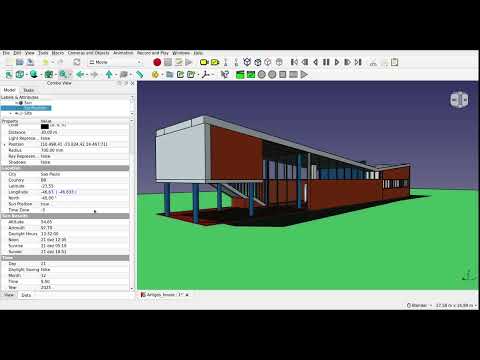
Here is a video as a proof of concept, showing the application of solar study animation using shadows, first in FreeCAD-Link (in colors), then in the main (in black and white). The studies are scheduled for the solstices and equinoxes. The shadow animation went smoothly!
The idea is to build a bench using some ladybug solar tools, let's see ...
Tagged:






 and 1 other.
Comments
The Solar WB installation files are already available:
https://github.com/Francisco-Rosa/Solar?tab=readme-ov-file
Testing, suggestions, and comments are welcome!
Here's one of my first attempts at creating a sky dome for the study of solar radiation. It seems the values of each color range still need to be adjusted further, before posting on GitHub.
Any comments and suggestions are welcome.
Obs.: Please, do not use this image as a reference! This is work in progress.
The sky domes will be available soon!
I would like to present the first tests for the next challenges, direct sun study (sun hours, images below) and sun irradiances in a volumetric context. Blue indicates lower values and red indicates higher ones.
The solar workbench has been updated with Sky Domes tools.
It's important to note that, as this is a first version, errors, and deviations in the results may still occur, which I request be reported in this forum.
In general, with Sky Domes, it is possible to generate solar radiation diagrams for a location at specific times. Below are examples from three different cities.
The main adjustments are:
Location (with indication of the respective epw file)
North,
Analysis period,
Legend adjustment (type and number of colors),
Position and radius of the sky domes,
Sky dome models,
Radiation types,
Total, direct and diffuse results,
Vector indication,
Adjustments to dome transparency.
Download and more information: https://github.com/Francisco-Rosa/Solar
The Solar WB already can be installed by the addon manager!
Here are some more images of the work in progress: sun analyses (direct sun hours, radiation and irradiance).
Hello,
I have just added the Solar Analysis tools on GitHub for testing, comments, suggestions, and questions.
To install WB, use the addon manager and accept the installation of the additional Python packages.
Install (manually) Radiance according to https://github.com/Francisco-Rosa/Solar/blob/main/Documentation/Installation.md
I still need to add the instructions for using Sun Analysis on GitHub. but, I've outlined the initial steps here: https://forum.freecad.org/viewtopic.php?p=874552#p874552.
IMPORTANT:
Please note that these results should be considered EXPERIMENTAL and are NOT yet recommended for use in professional work. They must be verified in some way. If you find any inconsistencies, please let me know in this forum.
Thank you.
Added to Software Directory
https://wiki.osarch.org/index.php?title=AEC_Free_Software_directory#Environmental_analysis_and_design
Thank you!
I've uploaded version 2026-02-26B to GitHub, ready for translation with other updates and fixes. I've also uploaded the translation file to Crowdin for this purpose.
Hello,
I ran a series of WB tests and fixed some bugs I found along the way. After that, I updated GitHub (version 2026-03-06).
Now, it's also possible to scale the titles and legend bar. Here are some images.
Hello,
I'm thinking of starting to apply honeybee libraries (energy and/or radiance) to FC, but I don't know the level of interest in this type of work.
https://www.ladybug.tools/honeybee-core/docs/
It would be quite a task.
In other words, would it be worthwhile?
If you could share your opinions, I would appreciate it.
Maybe working with radiance could gather more interest and attention. So you should focuses only on that. I heard that implementing EnergyPlus as pluging for SkethUp was a very hard task.
I can't help with lighting, but there is an IFC to gbxml converter that relies on IFC spatial boundaries (which can be created in Bonsai). These gbxml files will import into openstudio with a bit of help.
That sounds like good advice. Let's start with the less complicated honeybee radiance, then we'll see if we can move on to energy. Thanks!
It's good to know this. I've noticed this is a much-discussed topic on the FreeCAD forum. Let's see how we can resolve this. Thanks for the tip.
I've been chewing on this idea for a couple of years, whether to invest time in this ... It would certainly be a win for anyone trapped behind Rhino's paywall. I ended up having to get a license to R8 in order to finish a job so it relieved the pressure for now, as I can do my energy and daylighting work there. But this feels like one of those things that really should have happened by now so I suspect it would be appreciated by a niche that we could encourage to grow but probably wouldn't be met with immediate market adoption. Just a guess.
I also have this suspicion.
I would ask users like you, who have already performed solar analyses in other applications, to try the Solar Workbench and share their impressions, so we can improve it.
Thank you,
Hello,
Here are some images from a solar analysis of an urban study I've been developing.
The goal is to highlight that the method of lot-by-lot densification results in fragmented open spaces that are difficult to use, in addition to hindering good solar exposure for housing units, among other aspects.
On the other hand, using the city block as the minimum design unit allows getting better conditions to reach the desired and necessary urban spaces, soil permeability, uses, green areas, and solar exposure.
Roughly adopting reddish tones as indicating excessive sun exposure, yellowish ones as sufficient, and bluish as insufficient, the images already show an increase from approximately 25% (current) to 75% of sunlit areas in the alternative study.
I preferred to use radiation instead of direct sunlight because the former takes into account the climate data of the city analyzed (for instance, cloudy days).
Solar WB now has a French translation (version 2026.05.25)!
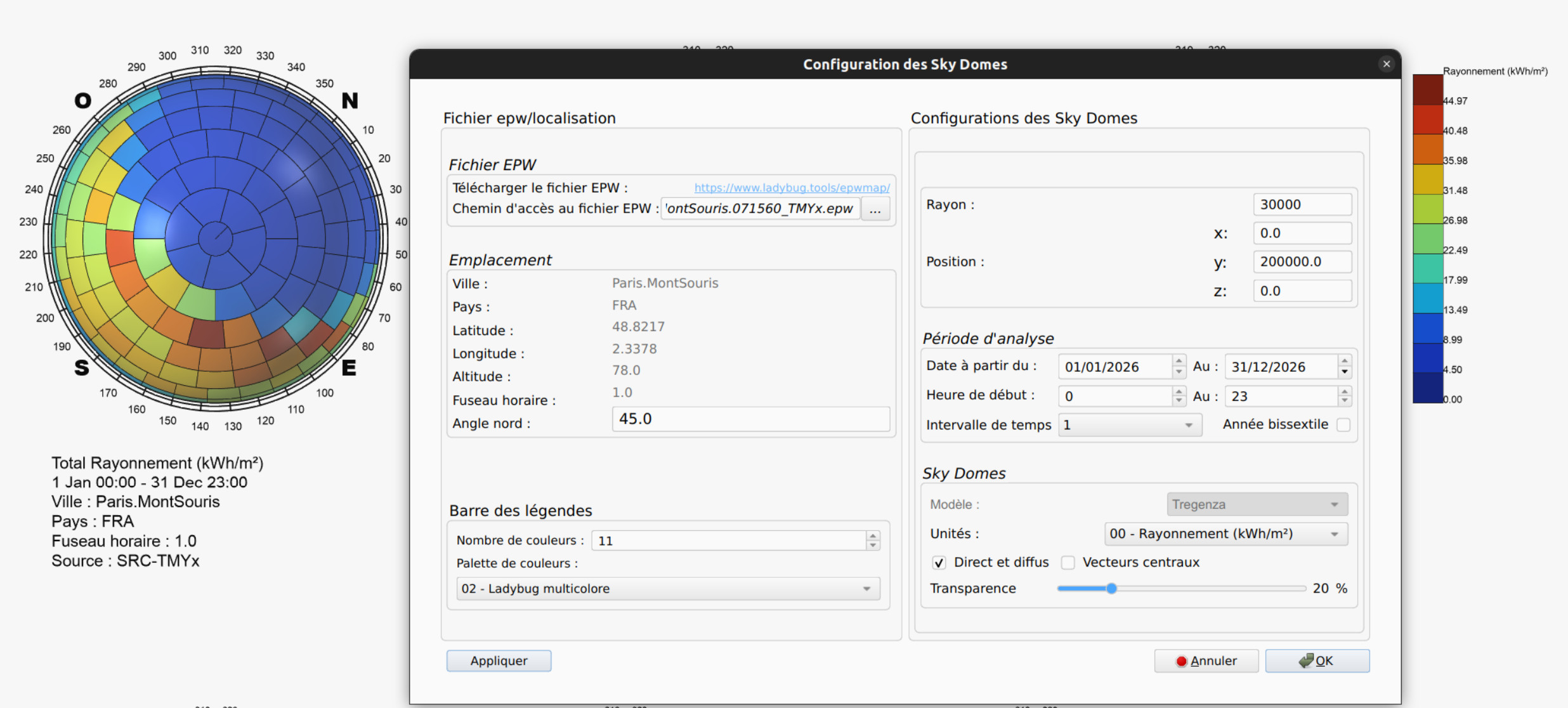
Tests and feedback are welcome!!